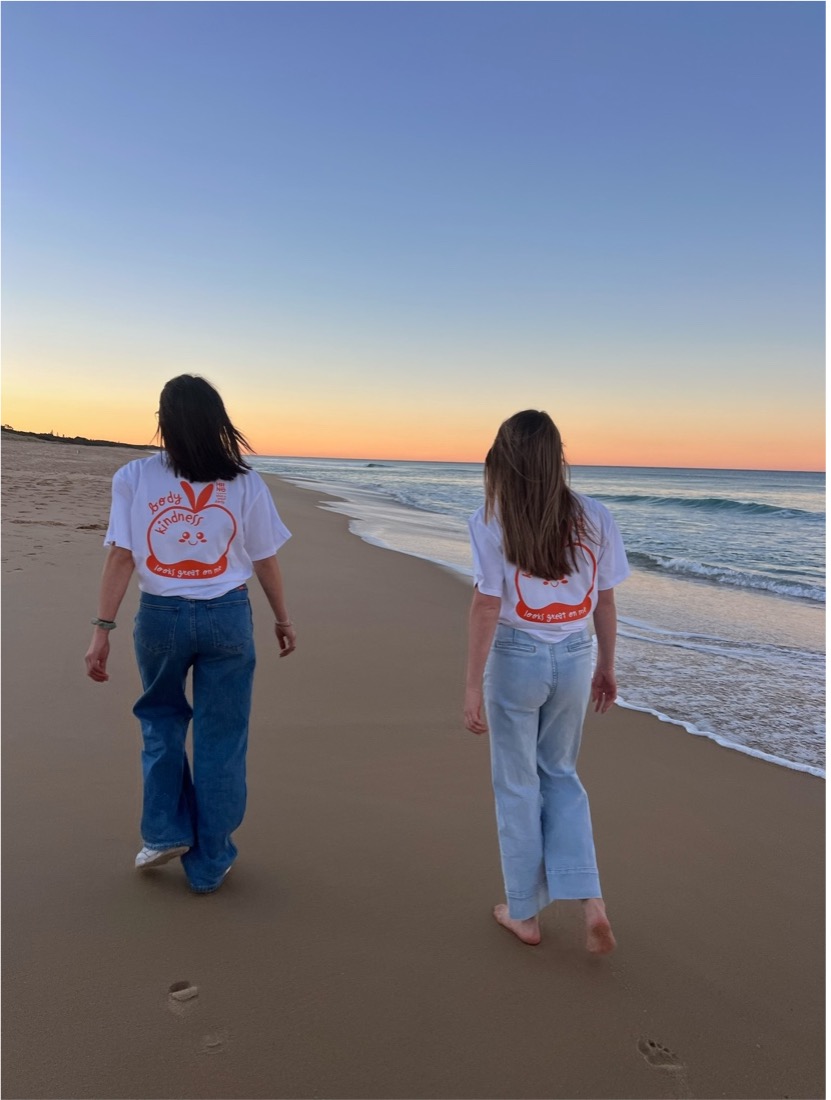
Carmen and I are delighted that our Body Appreciation Workbook is out in the world. We created this resource to provide an evidence-informed, interactive, and accessible resource for teens to guide them on the path to body appreciation.
Growing up, both Carmen and I struggled with our body image. We found it to be an isolating experience. There weren’t many resources available for young people to access, and we were left to work it out on our own using whatever we could find on the internet and social media. Determined to ensure that young people don’t have this same experience, we created the Body Appreciation Workbook.
It was really important to us that this resource was free and self-guided to ensure that it could be easily accessed and that there wasn’t a time limit on completing it. The path to body appreciation isn’t linear and we know that for some this workbook is going to bring to the surface challenging obstacles to move through.
Our hope for your young people working through the workbook is that they can foster a greater care, respect and understanding of their body and what it can do. We want them to feel proud of their body, but more importantly, we want them to feel proud of the person they are too. Afterall, the way we look is the least interesting thing about us.
So, how can you support your young person as they work their way through this workbook?
Here are our top three tips:
1. You can do the workbook together
Why not create your own account and complete the workbook alongside them? As you move through each section you can have discussions about what you’re learning, how you’re feeling, realisations, things that made you giggle and things you would like to explore further.
2. Have weekly check ins as they work their way through it
We recommend keeping dialogue open between you and your teen. The themes we cover may be ones that are new to your teen and that they want some support in moving through. Lead with curiosity, ask questions, invite them to share what they are learning and lean into the discussions. You can make an experience out of it too, perhaps before school on Fridays you can get a hot chocolate and chat about what has come up for that week. This ritual is one you can keep even after your teen has finished the workbook as a lovely way to stay connected and curious about their experiences.
3. Be mindful of the way you speak about your body
The young people in our lives often model their behaviours based on what they have seen. If they witness you being unkind to yourself, it normalises that behaviour. Watching a loved one show unconditional love towards their own body and that of others, demonstrates that no matter what a person looks like, they are worthy and lovable.
This can be hard to do in a world where we constantly have an unrealistic beauty standard being dangled in front of our eyes. We can create a new narrative for our young people by speaking kindly about our bodies and what they do for us. We can do this by saying things like, “I am so proud of my body”, “I appreciate my body”, “My body is so strong.” It might be uncomfortable at the start, particularly if this is something that you struggle with. Please know that you’re not alone if this is something you find hard and that you are always worthy of asking for support for your own body image.
We hope you feel really proud of yourself and your young person for taking this step towards appreciating your body. You will continue to have access to the tools and strategies after completing the workbook so that you can return to them if and when you and your teen need.
For extra support, we recommend reaching out to:
Carmen – For individual psychological support through Full Life Psychology
Gel (me) – For one-on-one support to improve your teens’ relationship with food visit This is Your Body
The Secret Burden – A charity that supports the parents of young people that are struggling with disordered eating
Embrace – For practical tools and strategies to foster positive body image in your home
The Butterfly Foundation – For the latest research and support in body image and disordered eating.
Eating Disorders Victoria and Eating Disorders Queensland – For support and education around eating disorders in both young people and adults.
Reviewed by Carmen Nielsen (BPsychSc(Hons), MProfPsych) and Ross Carlyon (BA, DipEd, Med Studies, DipSchoolAdmin).
You can explore the Body Appreciation Workbook right here. We hope it offers your teen a supportive space to connect with their body in a kinder, more respectful way.